


TL;DR
- What goji is: Goji berries (Lycium barbarum), also called wolfberries, are small red berries long used in Chinese cooking and traditional medicine. Outside China, they're mostly sold dried.
- Best-studied goji berry benefit: Eye health. Goji is one of the richest natural sources of zeaxanthin, and a small trial found a daily handful raised protective eye pigments.
- Still under research: Effects on immunity, blood sugar, liver and ageing come mainly from lab and animal studies. Goji's safety and effectiveness for chronic diseases haven't been established.
- Safety: Check with your doctor if you take warfarin or other blood thinners. Avoid goji if you have a lipid transfer protein (LTP) food allergy.
Goji Berry Benefits: What the Research Says & How to Use
Goji berries have been eaten for centuries in China, where they're part of everyday cooking and traditional medicine. Known as wolfberries (Lycium barbarum), these small, tangy red fruits are now sold worldwide as a "superfood".
In this guide, we look at the goji berry benefits that research actually supports, what's inside a handful, dried goji berries' benefits and drawbacks, everyday goji berry uses, what "organic goji berries" really means in India, and who should be careful.
What are Goji berries?
Goji berries are the fruit of Lycium barbarum, a shrub in the nightshade family. Most goji sold in India is imported and dried.
India has its own goji story too. Black goji (Lycium ruthenicum), a close relative, is being cultivated in Ladakh in trials led by DRDO's high-altitude research institute.
Goji berry nutrition: What's in a handful?
Goji berries are naturally rich in carbohydrates, with useful protein and fibre. A 2024 review reports:
- Carbohydrates: About 46–87% of dry weight.
- Protein: About 5–14% of dry weight.
- Fibre: About 3.6–16 g per 100 g.
- Vitamin C: Roughly 2–49 mg per 100 g of fresh fruit.
It also notes that nutrient levels vary with origin, cultivation and processing.
Goji's standout compound is zeaxanthin, a yellow-orange carotenoid. It makes up roughly a third to over half of goji's carotenoids, mostly as zeaxanthin dipalmitate. A 2016 review describes goji as the best-known natural source of it and reports dried goji at about 370 kcal and 5.5 mg of iron per 100 g.
What the research says about goji berry benefits
1. Eye health (The best-studied benefit)
Zeaxanthin is concentrated in the retina, where it helps form the macular pigment. In a small randomised trial at UC Davis, healthy adults aged 45–65 ate 28 g of dried goji five times a week for 90 days. Their protective eye pigments increased, while those of a group taking an eye supplement did not.
The study was small (13 people ate goji), and larger trials are still needed.
2. Antioxidant and immune effects (Early research)
Goji contains polysaccharides, flavonoids and zeaxanthin with antioxidant activity. Lab and animal studies report antioxidant, anti-inflammatory and immune-modulating effects.
However, the 2024 review above stresses that human trials are needed to confirm them.
3. Blood sugar (Preliminary only)
Memorial Sloan Kettering notes preliminary data suggesting a blood-sugar-lowering effect in people with type 2 diabetes. It isn't a treatment, and if you take diabetes medicines, talk to your doctor before eating goji regularly.
4. Liver, mood, fertility and cancer (Still being studied)
These effects are being researched, but they come mostly from lab or animal work. Memorial Sloan Kettering notes that the safety and efficacy of goji for chronic diseases have not been established.
Goji shouldn't be seen as preventing or treating cancer.
Dried goji berries benefits and drawbacks
Most goji you'll find is dried, and that has pros and cons:
- Convenient: Dried goji keeps well, travels well, and is easy to add to meals year-round.
- Concentrated: With the water removed, nutrients such as fibre, iron and carotenoids are packed into a smaller handful.
- Calorie- and sugar-dense: The same concentration applies to calories and natural sugar, at about 370 kcal per 100 g. A small handful (about 20–28 g) is a sensible portion.
Goji berry uses: Easy ways to eat them
- Breakfast: Stir a small handful into oats, muesli or yoghurt.
- Snacks: Mix into trail mix with nuts and other dried fruit.
- Drinks: Add to smoothies, or steep a few berries in hot water as a light tea or try a Himalayan berry tea, like our Vitali-Tea with sea buckthorn berries and leaves .
- Cooking: Simmer in soups and broths, as in Chinese home cooking.
- Baking: Fold into muffins, cookies or energy balls.
How much? There's no established therapeutic dose. As a food, a small handful is plenty. For context, the eye-health trial used 28 g, five times a week.
Build a Himalayan trail mix
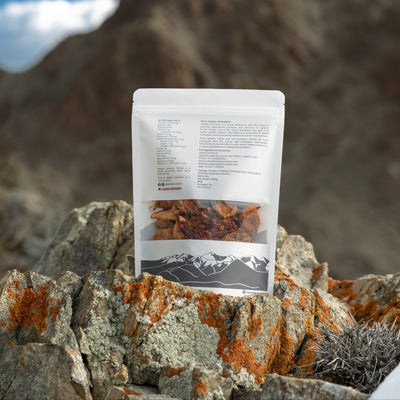
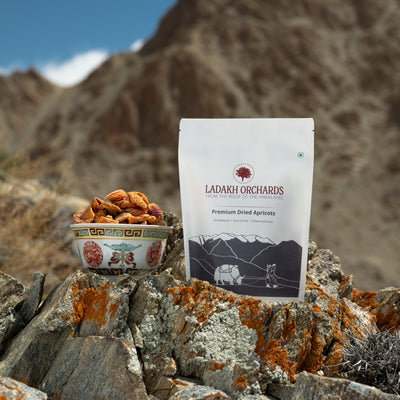
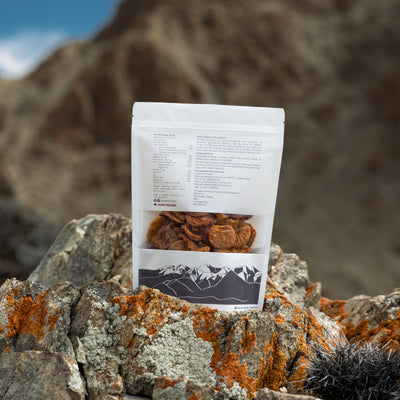
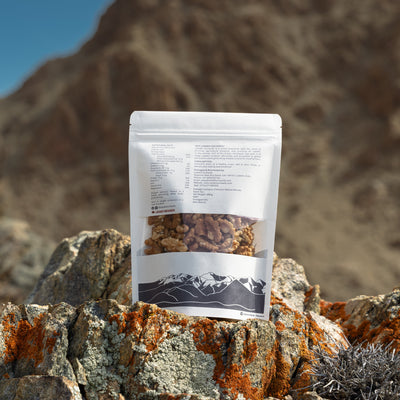
Pair goji with Ladakh's own dried fruit from My Pahadi Dukan. Our Himalayan Superfruit Mix blends sun-dried apricots, dried apples and wild sea buckthorn berries.




What the label should show about organic goji berries
If you're buying organic goji berries in India, the word "organic" alone isn't enough.
Under the FSSAI (Organic Foods) Regulations , organic foods are certified under the National Programme for Organic Production (NPOP) or the Participatory Guarantee System (PGS-India). The Jaivik Bharat logo is the official mark that separates organic from non-organic food.
A good bag will also list a single ingredient (dried goji berries), the country of origin, and whether any sugar, oil or sulphites were added.
Goji berries vs Himalayan sea buckthorn
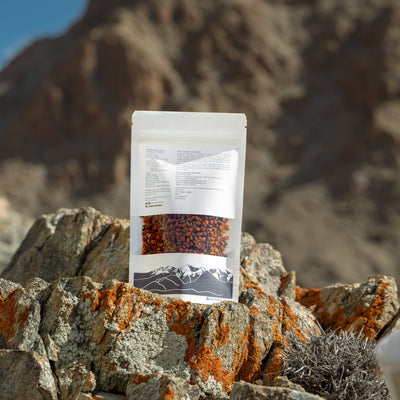
If you'd rather choose a berry grown closer to home, Ladakh's sea buckthorn is a vibrant Himalayan option, eaten dried or as pulp. It's the berry we source from Ladakh, hand-harvested by local farmers and dried with no added sugar.
Read about sea buckthorn berry benefits , or compare more options in our guide to berries in India .

Goji side effects and who should be careful
Goji is safe for most people as a food, but a few precautions matter:
- Blood thinners: There are case reports of raised INR and bleeding in people taking warfarin who drank goji tea or goji wine. Avoid goji products if you take warfarin or other anticoagulants, unless your doctor agrees.
- Other medicines: Lab studies suggest goji can affect liver enzymes that process many drugs (CYP3A4, CYP2C9 and CYP2C19). Check with your doctor if you take regular medication, including diabetes medicines.
- Allergies: Allergic reactions, including anaphylaxis, have been reported, especially in people with lipid transfer protein (LTP) food allergies.
- Pregnancy and breastfeeding: There's little safety data for concentrated goji supplements, so seek medical advice first.
- Digestion: Large amounts of dried fruit can cause bloating or loose stools, so keep portions small.
What to take away about goji?
Goji berries are a tasty, nutrient-dense dried fruit with one standout strength: zeaxanthin for eye health.
Many other claims you'll see online are still being studied. Enjoy goji as part of a varied diet, keep portions to a small handful, and check with your doctor if you take blood thinners.
Build your own Himalayan trail mix
Pair your goji with sun-dried apricots, dried apples and wild sea buckthorn berries from Ladakh.
FAQs on goji berries
Are dried goji berries as healthy as fresh?
Dried goji keeps most of its fibre, minerals and carotenoids, but calories and sugar are concentrated too. Some vitamin C may be lost in drying. A small handful is a sensible portion.
Are organic goji berries better?
Organic goji is grown under certified organic standards. In India, look for NPOP or PGS-India certification and the Jaivik Bharat logo. Nutrition is broadly similar, so freshness and quality matter most.
Can I eat goji berries every day?
Most people can eat a small handful daily as part of a varied diet. Avoid goji if you take warfarin or have LTP food allergies, and ask your doctor if you take regular medication.
Why do my goji berries taste bitter?
Bitterness usually points to old, over-dried or poorly stored berries. Some varieties are naturally slightly bitter. Check the date, store airtight in a cool place, and try a fresher batch.
How do goji berries taste?
Dried goji tastes mildly sweet and tangy, a little like a cross between cranberries and raisins, with a slightly herbal, earthy finish. Quality and variety change the sweetness.
Who cannot eat goji berry?
People on warfarin or other blood thinners, and those with lipid transfer protein (LTP) food allergies, should avoid goji. Check with a doctor if pregnant, breastfeeding or taking regular medication.
Frequently asked questions
What is Goji berry and what are other names for it?
How to eat goji berries?
What are the Goji berry benefits for the liver?
Are there any cancer warnings for Goji berries?
Ready to experience authentic Pahadi flavours?
Explore our collection of authentic spices, herbs and Himalayan ingredients directly sourced from high-altitude farmers.